
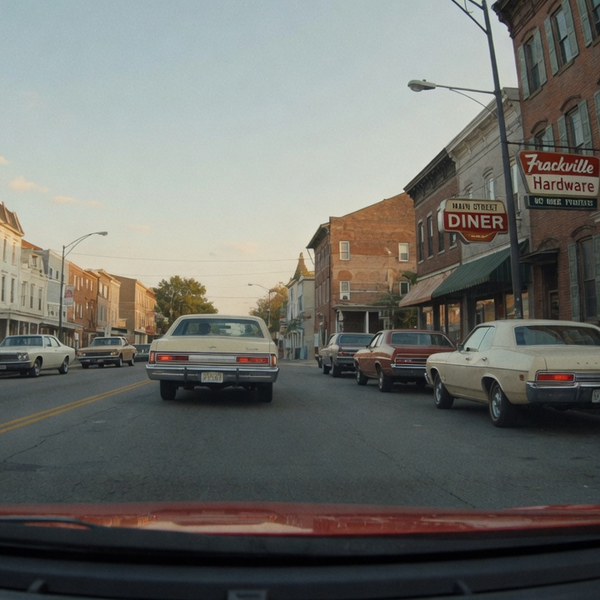
I wanted to make a demo of how modern AI video tools like MiniMax Hailuo / H3 could be used in movie production. Not a polished VFX breakdown. Just: take a real piece of reference, push it through the stack we actually have running, and see what comes back.
So I chatted with Flint in Slack.
Flint is my AI agent. He lives on an old gaming PC in the basement, talks to me over Slack through our Stranger Agents harness, and can kick off real jobs — image gen, video gen on Modal GPUs, audio analysis, deploys. Grok was handling the chat side of this session. The heavy lifting for pixels ran on Modal.
What follows is basically a recap of that thread, with the interim frames and the final cut embedded.
The prompt
I dropped this into Slack:
at 15:11 in this video there is a dash cam shot of a car driving around downtown frackville. Clip 15s of that and save the video. Then send that clip into h3 with a prompt to remove the camera overlay stuff, makes the video “cinematic” and most importantly makes the scene appear to be set in 1976. The dashboard, vehicles, buildings, shops, logos and everything should be from 1976.
Run this in the background. Also set a watcher that looks for the final video and then attaches it here.
Source video: Pennsylvania Route 61nb - Frackville to Centralia (MM 40 to MM 51) by YouTuber max1349.
Huge props to max1349. That channel is a goldmine of Pennsylvania road footage — long, steady dashcam drives with real small-town texture. We only used about 15 seconds of one block of downtown Frackville as reference geometry. The period restyle, the score, and the final cut are ours. If you like road videos of PA coal country, go subscribe to the original.
Step 1: Cut the source
Flint pulled the full video, cut 15:11–15:26, and posted the unrestyled dashcam clip back into the thread.
Modern dashcam look. GPS/HUD overlays. Contemporary cars. Exactly what we needed as a motion and layout reference — and exactly what we needed to erase.
Step 2: Restyle the keyframes
H3, the way we have it wired, is first/last-frame conditioned (FL2VA). It is not true video-to-video yet — Ref2VA isn’t hooked up. So the path is:
- Grab the first and last frames of the 15s cut
- img2img restyle each one into photorealistic 1976
- Animate between those two keyframes with MiniMax-H3 on a Modal H100
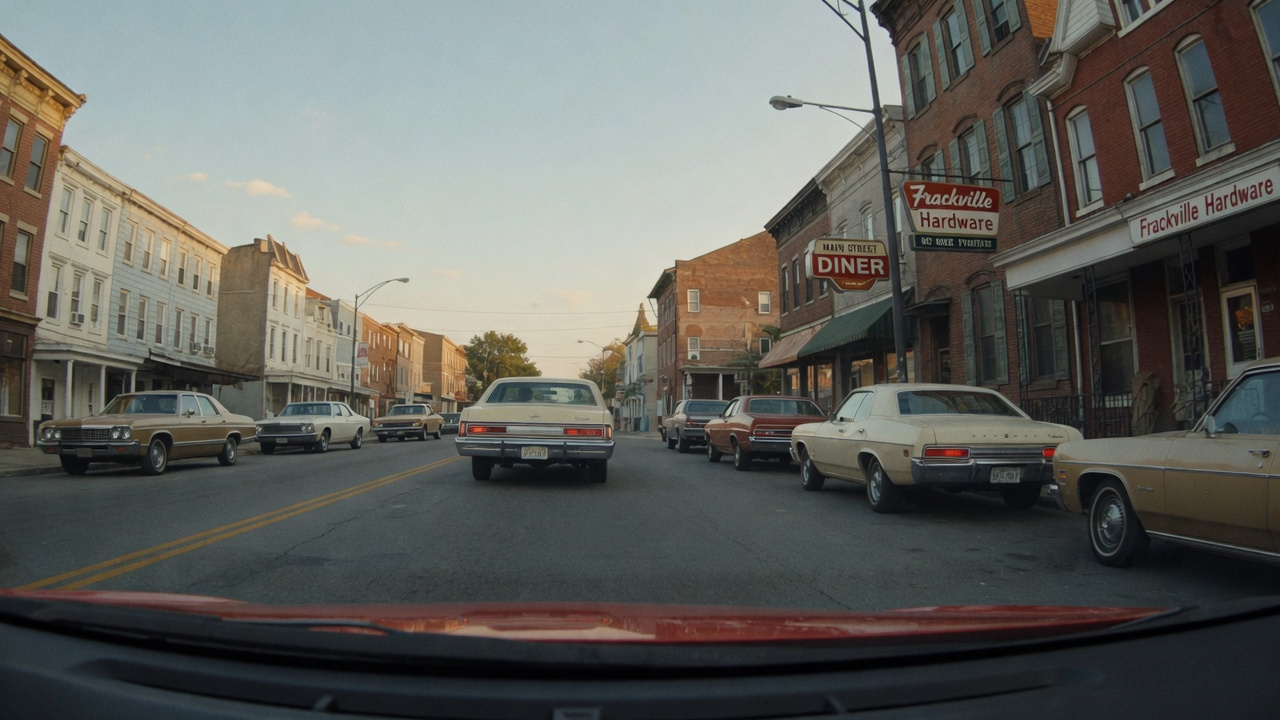
Flint ran the keyframe restyles through Grok image edit. Prompt gist: keep the windshield POV and road layout, strip every overlay, force period cars / brick storefronts / hand-painted signs / vinyl dash, Kodachrome late-afternoon grain.
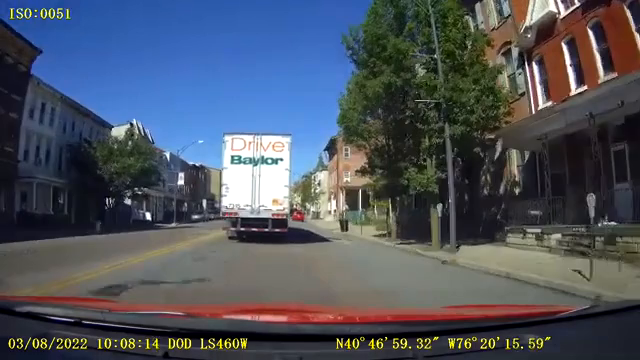
Source first frame → 1976 restyle:
Source last frame → 1976 restyle:
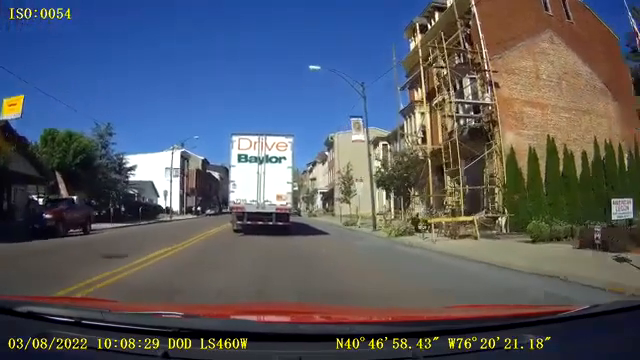
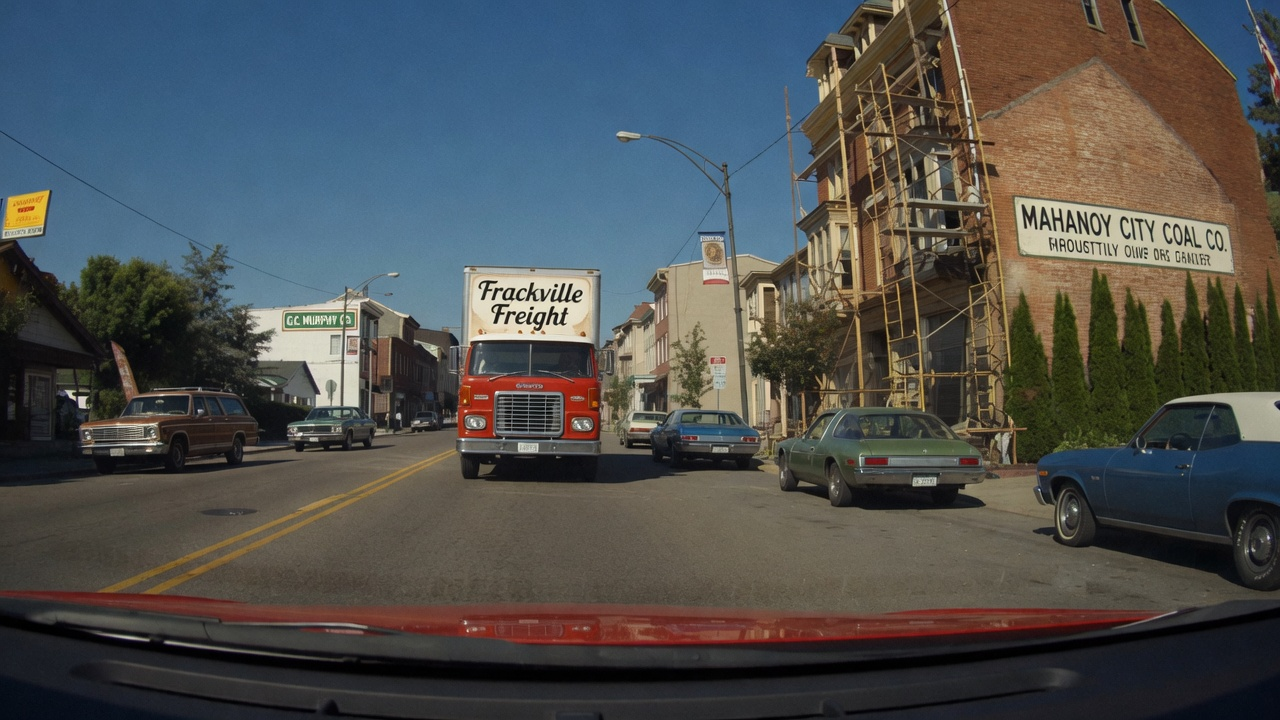
Overlays gone. Period cars in. The Main Street block still reads as the same place.
Step 3: H3 on Modal
Then Flint kicked MiniMax-H3 FL2VA on Modal:
- 960×544
- 345 frames (~15s)
- 40 steps
- seed
1976(obviously) - first/last images = the restyled keyframes above
Cold H100 spin-up takes a few minutes. A watcher script sat on the output path and attached the finished file back into the Slack thread when it landed.
While it was cooking, I watched the keyframes and noticed something:
Lol careful. That truck is in the wrong lane coming at the car. Could make for an exciting video though.
The geometry of the original dashcam put an oncoming truck in a weird place, and the restyle kept it. Feature, not bug. Instant tension for free.
The H3 picture (no score yet)
Cinematic 1976 drive. Overlays stripped. Wrong-lane truck still bearing down. Not a pixel-perfect edit of every intermediate frame of the original dashcam — FL2VA is interpolating between two restyled stills — but the POV and the roll of Main Street hold.
Step 4: Score it with The Chain
While the picture was landing I sent:
pull the audio of the chain from this video. analyze the audio to find the best 15s of the song to use for the clip. Use that as the background for the final clip. Your choice if you replace h3’s audio or mix it together.
Source: Fleetwood Mac – The Chain (Official Audio).
Flint pulled the official track, ran a full-track listen (Gemini) with a prompt aimed at “cinematic 1976 Main Street drive,” and locked the chorus at 54.0–69.0s — soaring hook, lush harmonies, steady drive groove. He also cut the cascading outro bassline at 185s and 200s as alts, in case we wanted more menace for the truck.
He delivered both:
- replace — Chain only under the picture
- blend — Chain + quiet H3 engine/foley under it
My pick was the chorus replace.
The final
Direct link if the player is being weird: frackville-1976-chain-chorus.mp4
Fifteen seconds. Real Pennsylvania dashcam → 1976 restyle → MiniMax-H3 → Fleetwood Mac chorus. End to end from a Slack thread.
What the stack actually was
High level, no vendor tour:
| Layer | What we used |
|---|---|
| Chat / director | Flint, via Stranger Agents, with Grok handling this session |
| Source pull + cut | yt-dlp + ffmpeg |
| Keyframe restyle | Grok image edit (img2img), 16:9 |
| Video gen | MiniMax-H3 FL2VA on Modal (H100) |
| Audio pick | Full-track listen → best 15s window |
| Mix + deliver | ffmpeg; watcher posts back to Slack; deploy to this site |
The important bit isn’t any single model. It’s that the agent can own the whole loop: pull reference, cut it, restyle stills, submit the GPU job, watch for the file, pick a music bed, mix, and publish — while I mostly send short Slack messages and react to what comes back.
What it cost
Ballpark for this one demo, from the actual run logs + public list prices (not a formal invoice):
| Piece | What ran | Estimate |
|---|---|---|
| MiniMax-H3 on Modal | 1× H100, ~11.3 min wall (12:44:37 → 12:55:57 ET). 960×544, 345 frames, 40 steps, seed 1976. Modal list: H100 SXM5 $0.001097/sec + 128 GiB mem | ~$0.95 |
| Keyframe restyles | 2× Grok Imagine Quality img2img @ 16:9 1K (first + last). ~$0.01/img list | ~$0.02–0.05 |
| Audio pick | 1× Gemini full-track listen on The Chain (~4:31) | cents |
| yt-dlp / ffmpeg / mix / deploy | local CPU on the basement box | $0 marginal |
| Chat / director (this Slack session) | Grok in the Stranger Agents harness — the long thread, tool calls, watchers | ~$1–4 (token-dependent; hardest to pin without the exact bill) |
Working total for the finished 15s cut: roughly $2–5.
The GPU line is the one people expect to hurt, and on Modal’s current H100 pricing it basically doesn’t — under a dollar for a cold 15-second FL2VA take. The chat session is usually the bigger variable once you’re iterating in Slack for a while.
What this does not include: the one-time cost of getting MiniMax-H3 weights and the Modal app wired the first time, any earlier failed experiments on other days, or “my time staring at the wrong-lane truck.” Also not a studio license for Fleetwood Mac — this is a process demo, not a cleared commercial.
If we ran ten variations instead of one, multiply the H3 line. That’s still lunch money compared to a real second unit day in Frackville.
What I’d do differently on a real production shot
- True video-to-video when we wire Ref2VA (or whatever the current H3 path is). FL2VA keeps composition; it doesn’t lock every intermediate frame to the source motion.
- More keyframes. First/last is the minimum. Mid-block anchors would keep storefronts and the truck honest across the full 15s.
- Audio rights for anything public-facing beyond a demo. The Chain is here because this is a process post and a demo. A real cut gets scored properly.
- Intentional staging of “happy accidents.” That wrong-lane truck is free drama. On a real shot I’d either lean into it on purpose or kill it on purpose — not discover it in Slack after the fact.
Why this matters to me
I’ve been making things with computers for a long time. The gap that just closed isn’t “can AI make a pretty clip.” It’s “can I direct a clip the way I direct a person” — short notes, reference links, taste calls (“chorus replace, not the outro”), and a collaborator who runs the toolchain without me opening five tabs and a terminal.
Frackville is personal geography for me. Seeing a real block of it dropped into 1976 in an afternoon, from a phone, is the demo I wanted.
First pass, not final
Lots of issues in the video if you look. This is just the first pass. Next step, if the shot was storyboard-roughly useful, would be to make it again and attempt to fix the misspellings, odd people, and inconsistencies.
Then of course you put this footage in the hands of an experienced editor and compositor to fit into the film. All the same tricks they use to hide wires and other filming artifacts — they can use those to hide the AI errors too.
Thanks again to max1349 for the source drive, and to Flint for not dropping the watcher.
If you want more of how we work with agents day to day: How We’re Using AI Agents at Work and I Don’t Do Anything Without Flint Anymore.